
Best Spotify Equalizer Settings For Enhanced Listening Experience
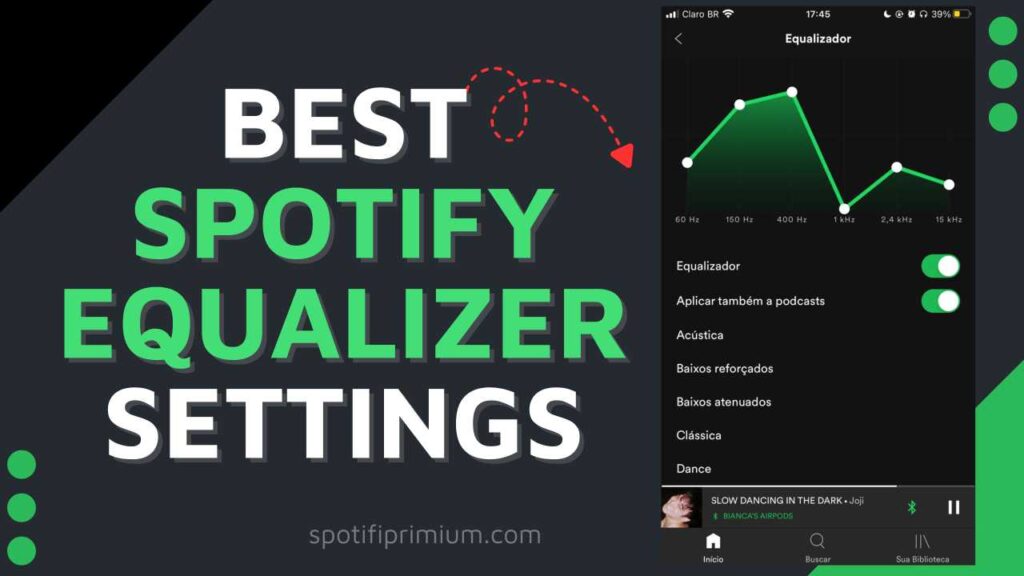
The human hearing range is 20Hz to 20000Hz. The sounds below 20Hz are called infrasound, and those above 20000Hz are known as ultrasound. Beyond this range, we are not able to hear the sound of certain frequencies, like the call of an ant or the sound emitted by the sun or other planets.
But interestingly, we have managed to use our creativity to combine various sound effects and make a musical melody that soothes our minds. Even many of us can modulate our vocal cords and produce a fine and attractive euphonious voice that can act like music.
What is Spotify Equalizer and How Does It Work?
The Spotify Equalizer is a tool on the Spotify music app that allows the listener to experiment with the sound of the music by tuning the musical frequencies up or down, making the melodies suitable to the ears. The Equalizer, also known as EQ, has given access to the professional-level music settings that allow all melophiles to adjust the bass, lighten up the loud tones, and tune up the entire sound spectrum.
An Equaliser is a tool that separates the frequencies of a sound spectrum and allows the person to modify the bandwidths of the notes. There are notable, three sorts of frequency, namely-
- Low frequency, which has a range from 60kHz to 150kHz.
- Mid frequency has a music range from 150kHz to 1kHz.
- High frequency has a sound range starting from 1kHz to 15kHz.
This range includes all the sounds when combined together, creating a musical note. This note has all the high bass and low trebles of the vocals and melodies formed by the musical instruments.
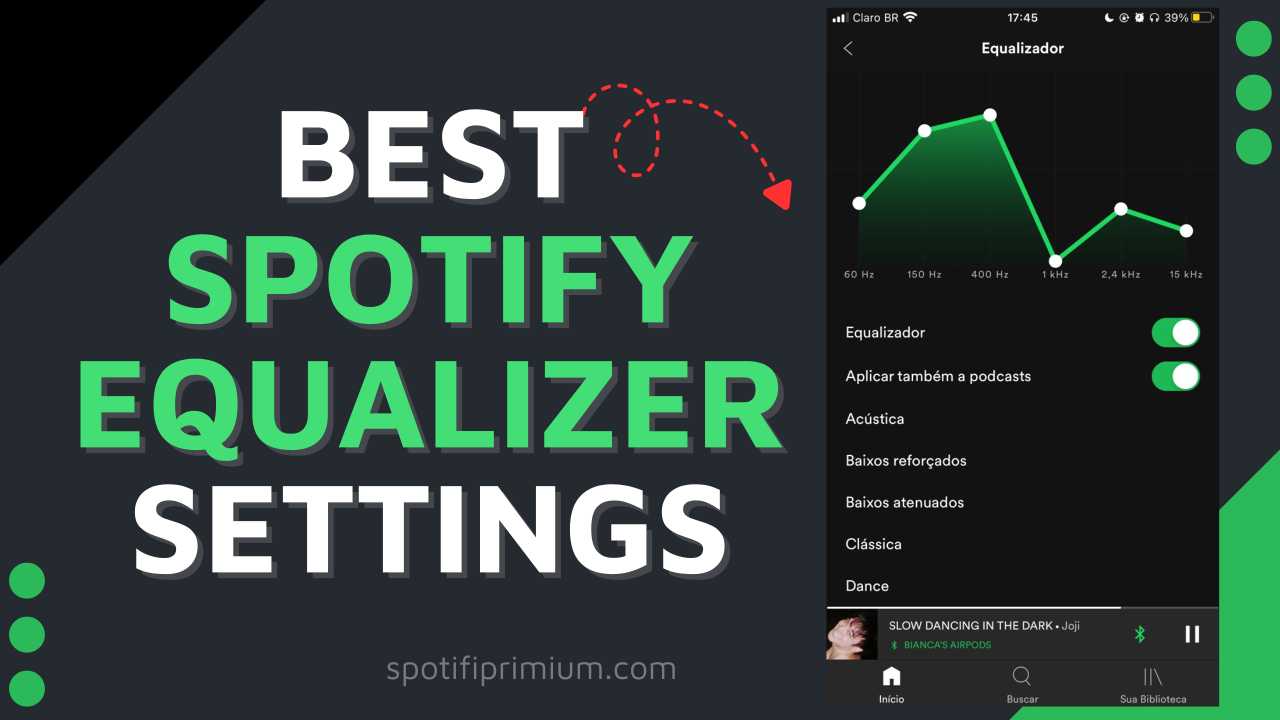
Best Spotify Equalizer Settings for Balanced Sound
The Equalizer tool on Spotify is pretty much complicated for normal people, but if understood, then it can be quite handy in controlling your own music streaming services. The components of the EQ tool are quite complex, and one has to grasp its meaning and how it functions.
When a person opens the EQ panel, they will notice a chart-like setup. This is the setting of EQ, which allows a user to control and modify the songs and music tracks on Spotify. The six ‘white dots’, as seen on the panel, are the bands that set the range of every individual frequency. Initially, the bands appear in a straight row, aligning themselves upon the green line, which signifies that the soundtrack is set at par, the original composition. The green line denotes 0dB, and if the user wants, they can move the bands perpendicularly to the green line. By doing this, it will result in increasing or decreasing the bass and treble notes of the music.
The panel has two numerical values displayed on the screen, apart from the frequencies. There are ‘+12dB’ and ‘-12dB’ on the top and bottom of the EQ panel, respectively. This is the range for the bands that will decide the volume of each frequency individually in the music composition. If the user wants to start fresh, then there is a feature called ‘Preset’ on the top left side of the screen. They can click on that box and select ‘Reset’, which will result in positioning each band back to its original place.
Best Spotify Equalizer Settings for Vocals and Podcasts
The vocals of a song or in a podcast can be made clearer now, thanks to the EQ setting. The vocals can be taken care of by setting up a high-pass filter at a range of 80-100Hz, which will remove all the background noises in a podcast and the low-frequency sounds in a song. Alongside, increase the vocal frequencies in-between the range of 1kHz to 4kHz, which will result in enhancing the vocal cords of the singer with clearer lyrics.
Professionals use the high-pass filter to remove any rumbling sound or bass in a podcast. By starting from 80Hz, the user has to lower it to a point above 60Hz that will completely thin out the bass and make the voices in the podcast sound clearer and professional in nature.
Best Equalizer Settings for Rock, Pop, and EDM Music
The Spotify EQ can modulate each and every music genre if the user has the basic idea of how to work it up. Different music genre has different ranges for the bandwidths. For example, Rock and Metal music has high bass and beats with a shrilling voice, which will be drastically different from the musical composition and the tune structure of Classical music.
For Rock genre music, the typical adjustments should look like:-
60Hz at +3dB, 150Hz at +2dB, 400Hz at +1dB, 1kHz at +2dB, 2.4kHz at +1dB and 15kHz at +3dB.
For Pop music, one can follow this schematic for their EQ tool:-
60Hz at +3dB, 150Hz at +2dB, 400Hz at +1dB and 15kHz in between +3dB and +4dB. The rest can be kept unchanged.
For EDM music, the following modulations will be required:-
60Hz at +5dB, 150Hz at +3dB, 400Hz at -1dB, 1kHz at +2dB and 2.4kHz at +4dB.
Does Spotify Equalizer Affect Audio Quality and Battery Life?
Spotify Equalizer is a tool, or it can be called an additional processor for adjusting and tuning the music. This means that the EQ will use some battery power of the device as it is modifying the frequencies of certain musical elements, while amplifying a few sounds. Necessary adjustments and boots can use up some battery charge as it changes the musical sound quality.
The audio quality depends on the user’s tailoring skills. The Spotify Equalizer can change, improve, and enhance the audio quality as it is meant to do. The whole purpose of the EQ is to give a chance to the listener to improve the music according to their taste and liking by tuning up and down the frequencies. The user should be aware of their actions, as too many changes in the band positioning without any proper thought can ruin the music quality.
As for the battery life, the EQ is using up extra power from the device battery, but it is almost negligible. Still, if it is used for a prolonged period, then it can affect the battery significantly.
Common Mistakes to Avoid When Using Spotify Equalizer
- Overboosting all frequencies: The frequencies should be regulated carefully otherwise any haphazard tuning will ruin the music and the sound.
- Excessive bass levels: The louder the bass, the lower the other musical notes get. Bass should be regulated accordingly, neither too high nor too low.
- Using one EQ for all genres: Using a single equalizer pattern for all the music genres will result into an unsatisfactory musical note and even chaos.
- Random slider adjustments: Adjusting the bands randomly without any observation and understanding will lead to a mess and cacophony.
- Not comparing EQ on and off: The user should always compare the music, both before and after using the equalizer. This comparison is necessary so that the listener can make certain changes to the highs and lows of the notes.
Share Your Thoughts